401(k) Plans
What to Ask An Advisor For your 401k Plan?
Before hiring an advisor for you 401(k) plan, you should ask them, “How many group retirement plans do you work with?” At Retirement Wealth Partners, we work with numerous retirement plans in the Southwest and leverage our experience to make this benefit as fruitful as possible to you and your employees. Contact us if you have any specific questions about your plan and we would be happy to schedule a meeting with you.
Below are questions we get all the time from plan sponsors, participants and business owners:
What is a 401k Plan?
A 401k plan is a qualified group retirement plan articulated in the Internal Revenue Code section 401(k). It is a plan that helps employees save for retirement throughout their working years. A 401(k) plan is considered a defined contribution plan, meaning the benefit is correlated to how much the employee and employer contribute into the account. A 401(k) plan is different from a pension plan as it does not guarantee a specific benefit in retirement, but instead allows the employee to contribute throughout their working career.
Who Makes up a 401k Plan?
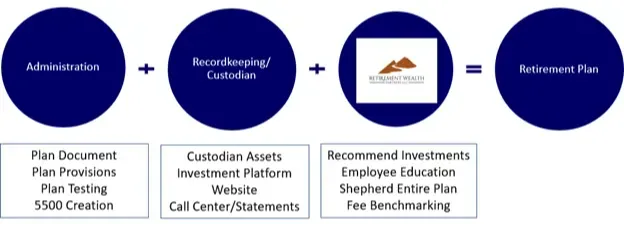
Are 401k contributions tax deductible?
One of the great benefits of a 401(k) plan is that employees can make contributions on a pre-tax basis. What does this mean? It means that when you contribute to your 401(k) on a pre-tax or traditional basis, you do not have to pay state or federal income taxes. This makes your contribution tax deductible as it reduces your tax liability for the current year. The funds grow on a tax deferred basis, which means that you will have to pay income tax when the funds are withdrawn in retirement after you turn 59 and ½ years old.
However, many plans allow a Roth contribution as well. If you contribute on a Roth basis, your contribution is not tax deductible for your current year. The benefit of a Roth account is that after you pay federal and state income taxes, withdrawals from this account can be tax free if you are over 59 and ½, retired, and had the account at least 5 years.
The same is true for the employer match. If the match is contributed on a pre-tax basis, they do not have to pay Medicare or social security tax on the match. These tax advantages are a great reason to offer this plan for your employees.
It is important to note, that Retirement Wealth Partners are not accountants. Please consult your tax preparer to validate any information regarding you tax liability.
Can a 401k be rolled into an iRA?
Yes! When you are no longer working for the employer that sponsors your 401(k) you are able to rollover your 401(k) account into an Individual Retirement Account (IRA). The account has to rollover in kind, meaning a Roth account to a Roth IRA and a pre-tax account to a pre-tax IRA. This rollover does not create any taxation but there are steps necessary to complete this administrative action. There are multiple options to consider when thinking about rolling over your 401(k). Please see important information further down the page.
Call Retirement Wealth Partners so we can help you navigate this process with your 401(k) record keeper and open an IRA for you.
Where should I be to stay on track with my 401(k) account?
To shed light on whether you are on track, we’ll have to do the math. There are a few popular formulas you can use: the Rule of 4 Percent, Multiply by 25 Percent Rule, or the Retirement Account Multiple (RAM).
Fortunately, there are a lot of easy-to-use calculators on this website that will help you get a sense of whether you are on track. You just need to plug in some basic information.
If you have any specific questions, we are here to help! Give us a call and we can talk through your savings plan and give some insights on if you are track for retirement.
Who gets my 401(k) account if i die?
This is a hard question as it can be difficult to think about your own mortality. However, it is an important topic that is often overlooked. You can add a primary and contingent beneficiary onto your 401(k) plan to reduce any unintended consequences. When you invest in a beneficiary-named financial account, such as a 401(k), you should name the individuals or institutions you want to receive the assets in the account when you die.
These are designated as your primary beneficiaries. A contingent beneficiary is someone or something that receives the benefits of an account if the primary beneficiary can't or won't do so after the account owner's death. Contingent beneficiaries stand in the wings, next in line to inherit assets if something should go wrong. Think of them as a backup plan.
Things to know when designating your 401K Beneficiary:
- Don’t leave the beneficiary form blank! Failing to name a beneficiary is a big mistake because doing so could deprive your heirs or loved ones of inheriting your retirement assets. Another downside is that your retirement assets would go through probate, which is basically the legal process of proving a will, a lengthy, and possibly costly, process which will delay your assets being distributed.
- Don’t designate your estate as the beneficiary. Although it can be, your estate should never be the named beneficiary of a 401(k). To do that, either on purpose or simply by failing to name a beneficiary, means the 401(k) money will be disposed of by probate court, which may also delay the distribution for your heirs for months or even years.
- Beneficiary designations take precedence over wills. Retirement assets are distributed according to the named beneficiary, regardless of other agreements such as wills. So don’t assume if you have a will, that your wishes will be carried out if they don’t jive with the beneficiary form on your 401(k) accounts.
- Keep your beneficiary designations current. Many people fail to update their beneficiary designations after major life events, such as: marriage, divorce, new additions to the family, relationship changes, death to a named beneficiary
Lastly, consult an expert if you aren’t sure who to name as your beneficiary. Experts would include an estate attorney or a tax professional.
401(k) vs IRA
As you start approaching retirement, we get questions all the time about the difference between a group retirement plan, like a 401(k) and an IRA. A 401(k) is a group retirement account while an IRA is an Individual Retirement Account. 401(k)s have a higher income limit than IRAs do for Roth contributions. Additionally, the limit of your contributions is much higher in a 401(k) than an IRA. Meaning you can use a 401(k) to save more for retirement annually than you could in an IRA. You may have more investment options available through an IRA than in your group retirement plan.
For these reasons, we like to say that your 401(k) is a great wealth accumulation tool but an IRA may be the better distribution tool. When you roll over your 401(k) account into an IRA you often times gain greater flexibility to distribute what you want, when you want, and how you want. These distributions of your funds from an IRA may not have a distribution fee or a reduced rate when compared to a 401(k) plan. This nimbleness allows a payment schedule that can mirror your current pay structure in retirement.
*If you are considering rolling over money from an employer-sponsored plan, you often have the following options: leave the money in the current employer-sponsored plan, move it into a new employer-sponsored plan, roll it over to an IRA, or cash out the account value. Leaving money in a plan may provide special benefits including access to lower-cost investment options; educational services; potential for penalty-free withdrawals; protection from creditors and legal judgments; and the ability to postpone required minimum distributions. If your plan account holds appreciated employer stock, there may be negative tax implications of transferring the stock to an IRA. Whether to roll over your plan account should be discussed with your financial advisor and your tax professional
If you have any questions about if and when you should roll over your 401(k) into an IRA gives us a call and we can talk with you.
Retirement Guidance for Employers
We realize there is no one-size-fits-all retirement plan solution, so our support and services are tailored to fit what’s best for you and your company while helping to ensure the financial wellness of your employees. Get the most out of your plan by partnering with us every step of the way.
Investment Support
We help you draft an effective Investment Policy Statement and make sure that you can offer a range of suitable investment options.
Customized Education Programs
We’ll help your employees plan for today and save for their future with a focus on financial wellness as part of their overall retirement goals.
Experienced Guidance
Consider us an extension of your HR department. We’ll simplify the management of your plan and allow you more time to focus on other aspects of your business.
Fiduciary Know-How
We follow a disciplined process that helps ensures your plan is operating within the latest fiduciary guidelines, leaving you confident that you’re serving the best interests of your employees.
Keeping a Focus on Your Financial Future
As the team that manages your company’s retirement plan, we can work with you to help ensure you stay on track to meet your long-term goals. We’ll guide you to make wise decisions now, and as your circumstances change. You can rely on us to:
Help you set realistic savings goal that fit within your budget.
Provide additional tools that allow you to analyze your savings strategy.
Develop an approach that aligns with your investment preferences and risk tolerance.
Discuss the features of your plan to be sure you get the most out of the benefits offered
Your Fiduciary Planning Partners
Retirement Wealth Partners delivers financial guidance with integrity and compassion at its heart. Reach out to learn how we can serve your needs.